
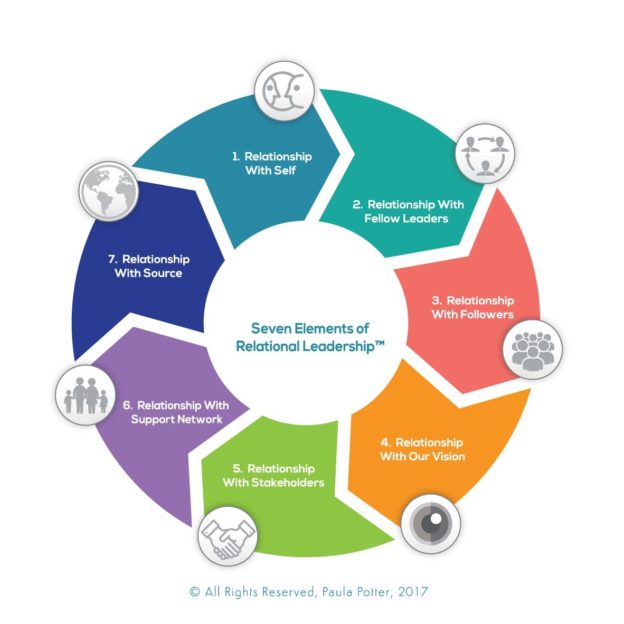

I. Relationship With Self
a. Self-Awareness
b. Self-Discipline
True leaders must be fully self-aware of their own behavior and how it affects those around them. Through greater self-awareness, leaders can create new habits that will allow them to grow and evolve as a leader. This requires self-discipline and a focus on emotional intelligence. Continuous self-development is the foundation of becoming a Relational Leader.

II. Relationship With Fellow Leaders
a. Respect
b. Integrity
We cannot have lasting success on our own merits. As the saying goes, “a rising tide lifts all boats”. Through showing respect to fellow leaders and acting with integrity at all times, we work to strengthen all relationships within our organization. As a result, everyone wins, and we create a culture where people want to come to work.

III. Relationship With Followers
a. Honesty & Trust
b. Adaptability
Trust is at the core of all relationships. As a relational leader, one of our main roles is to create an environment where there is a high level of trust, people tell the truth and can get aligned with the Purpose, Values and Vision of their team and the organization as a whole. As leaders, we must also learn how to adapt our behavior to meet the needs of our followers.

IV. Relationship With Our Vision
a. Ability To Deal With Conflict
b. Developing Our Intuition
For an organization to progress toward its Vision, it is essential that its leaders constantly articulate and communicate where they want the organization to go. Leaders must also be able to deal with conflicts, both internal and external, and be able to utilize their own intuition and other data to get back on track when they are off course with any of their constituencies.

V. Relationship With Our Stakeholders
a. Responsibility
b. Accountability
Stakeholders have a vested interest in the success of our organization. Stakeholders could include but are not limited to shareholders, customers, Board of Directors, employees and vendor partners. As leaders we must have a clear idea of our responsibilities and the ways in which we are accountable to our stakeholders, as well as our stakeholders’ responsibilities to us.

VI. Relationship With Our Support Network
a. Priorities
b. Reciprocity
The support of friends and family is an essential element in our success as leaders but is often something we take for granted. To be effective leaders we must understand the importance of this support and ensure that our priorities reflect this by making time for supporting those who support us.

VII. Relationship With Our Source
a. Humility
b. Focus On Bigger Picture
The relationship with our source is what gives us strength beyond ourselves. For many of us it might be our relationship with God, or a sense of a higher power. An important trait involved in this relationship is the ability to keep the bigger picture in perspective. Humility and a down to earth look at how we feel about our lives can act as a guide to our relationship with our source.